-
 Timely, intimate and important, the long-awaited memoirs from one of the most influential leaders of our timesFor 16 years, Angela Merkel was Chancellor of Germany. She led the country through numerous crises, shaping both Germany and international politics with her actions and attitudes. In her memoirs, co-written with her long-time political advisor Beate Baumann, she reflects on her life in two German states – 35 years in the German Democratic Republic, 35 years in reunited Germany. More intimately than ever before, she talks about her childhood, youth, and studies in the GDR and the dramatic year of 1989, when the Berlin Wall fell and her political life began. She also shares recollections and insights from her meetings and conversations with the world's most powerful people. Discussing significant national, European, and international turning points, she shows how the decisions were made that shaped our times. Her book offers a unique insight into the inner workings of power – and is a compelling plea for freedom.
-
 A landmark survey of how textiles have been used for political protest in the 20th and 21st centuries, including banners, flags, clothing and pieces from the world of fine art. Textile Protest showcases the richness and diversity of textiles that have been used to express resistance in its many forms. Protest textiles can be confrontational and explicit, satirical and subversive or ironic and humorous, and can be used to bridge gaps following conflicts, or to challenge the contentious issues of language, ideology or imbalances of power. Whether for social justice or peace, to demonstrate opposition to oppression or to celebrate liberty, to honour hope and equality or to express solidarity with others, people have made and united behind protest textiles for hundreds of years. This book forms a valuable history of their use. The book is thoughtfully illustrated with examples that include heavily embroidered suffragette and trade union banners, the knitted pussyhats of the 2017 Women’s March, protest textiles from the Guerrilla Girls, Pride flags that celebrate the LGBTQ+ community, and the vast variety of textile art in support of the Black Lives Matter movement. It also covers the rich history of fine art textiles with a political theme, such as Judy Chicago’s iconic 1970s installation The Dinner Party, and includes interviews with prominent activist artists that give further insight into the way everyday materials can be repurposed to create arresting political art. Bold and subversive, beautiful and fascinating, Textile Protest is an important global exploration of how fabric has been used to make a political statement over the years. ISBN 9781849949071
-
 A groundbreaking new history of the people at the centre of Europe, from the Second World War to todayIn 1945, Germany lay in ruins, morally and materially. The German people stood condemned by history, responsible for a horrifying genocide and a war of extermination. But by 2015 Germany looked to many to be the moral voice of Europe, welcoming almost one million refugees. At the same time, it pursued a controversially rigid fiscal discipline and made energy deals with a dictator. Many people have asked how Germany descended into the darkness of the Nazis, but this book asks another vital question: how, and how far, have the Germans since reinvented themselves?Trentmann tells the dramatic story of the Germans from the middle of the Second World War, through the Cold War and the division into East and West, to the fall of the Berlin Wall and the reunited nation's search for a place in the world. Their journey is marked by extraordinary moral struggles: guilt, shame and limited amends; wealth versus welfare; tolerance versus racism; compassion and complicity. Through a range of voices - German soldiers and German Jews; environmentalists and coal miners; families and churches; volunteers, migrants and populists - Trentmann paints a remarkable and surprising portrait over 80 years of the conflicted people at the centre of Europe.
-
 Between the fifth century and the ninth, several thousand churches were founded in Ireland, a greater density than most other regions of Europe. This period saw fundamental changes in settlement patterns, agriculture, social organisation, rituals and beliefs, and churches are an important part of that story. The premise of this book is that landscape archaeology is one of the most fruitful ways to study them. By looking at where they were placed in relation to pagan ritual and royal sites, burial grounds, and settlements, and how they fared over the centuries, we can map the shifting strategies of kings, clerics and ordinary people. The result is a fascinating new perspective on this formative period, with wider implications for the study of social power and religious change elsewhere in Europe. The earliest churches, founded at a time of religious diversity (400-550), were often within royal landscapes, showing that some sections of the elite chose to make space for the new religion. These often lost out to new monasteries positioned at a remove from core royal land, making it possible to grant them the great estates on which their wealth was based (550-800). Now, however, founding churches was no longer a prerogative of kings for we see numerous lesser churches outside these estates. In this way middle-ranking people helped transform the landscape and shape religious cultures in which rituals and beliefs of local origin co-existed alongside Christianity. Finally, in the Viking Age (800-1100), some lesser churches were abandoned while community churches began to exert more of a gravitational pull, foreshadowing the later medieval parish system. ISBN 9781782054306
-
 Between 1919 and 2011, the president of Ireland was a married person. Yet, there is no reference to the president’s family in the 1937 Constitution. Beyond media curiosity, public discussion and scholarly interest in the wife or husband of the president is surprisingly rare. This study recreates the public and private lives of Irish presidential spouses including Maud Griffith, Louisa Cosgrave, Phyllis Úi Cheallaigh, Sinéad de Valera, Rita Childers, Máirín Ó Dálaigh, Maeve Hillery, Nick Robinson and Martin McAleese. Following an examination of the role of the wife of the viceroy, the work focuses on how the experience of being the wife or husband of a president affected the individual’s personal life, their ambitions, and expectations. They did not have guidelines or prescriptive advice on how to behave in office, except for the practices of previous incumbents, perhaps international models, their own view of public service and guidance from civil servants. The study explores the idea that while the incumbents seem to have had little in common except that their husbands or wives held the same post, there were common threads in their backgrounds and lives. Each individual had a sense of duty and held a concept of public service which evolved in different ways. The study explores whether the spouse of the president should be accorded greater respect and status, and an acknowledgment of their place in the institution of the presidency
-
 It is often forgotten that leaders of the Irish Revolution considered the domestic and international campaigns for Irish independence to be organically linked. Focusing on this dimension can relocate the Irish struggle in its original and fullest context. This collection of essays follows the activities of Irish envoys abroad over four years as they defended the right of Dáil Éireann to self-determination and lobbied for its recognition in the capitals of Europe and the British Commonwealth, as well as in the United States. The global impact of Terence MacSwiney’s hunger strike protest is highlighted, as well as the important role played by Catholic networks, disapora activists and women volunteers. By reconsidering its international dimension, this book locates the Irish Revolution within an appropriate background of post-war settlements that were not only contested but also remained comparatively fluid. Cultural repercussions of the Irish struggle are also examined at a time of growing international debate about small, emergent states and the existence of contested state boundaries arising from the upending of the old international order caused by the First World War.
-
 The Enlightenment is one of the formative periods of Western history, yet more than 300 years after it began, it remains controversial. It is often seen as the fountainhead of modern values such as human rights, religious toleration, freedom of thought, scientific thought as an exemplary form of reasoning, and rationality and evidence-based argument. Others accuse the Enlightenment of putting forward a scientific rationality which ignores the complexity and variety of human beings, propagates shallow atheism, and aims to subjugate nature to so-called technical progress. Answering the question 'what is Enlightenment?' Kant famously urged men and women above all to 'have the courage to use your own understanding'. Robertson shows how the thinkers of the Enlightenment did just that, seeking a rounded understanding of humanity in which reason was balanced with emotion and sensibility. His book goes behind the controversies about the Enlightenment to return to its original texts and to show that above all it sought to increase human happiness in this world by promoting scientific inquiry and reasoned argument. His book overturns many received opinions - for example, that enlightenment necessarily implied hostility to religion (though it did challenge the authority traditionally assumed by the Churches). It is a master-class in 'big picture' history, about one of the foundational epochs of modern times. ISBN 9780241004821
-
 A bold new approach to the Second World War from one of Britain's foremost military historiansRichard Overy sets out in Blood and Ruins to recast the way in which we view the Second World War and its origins and aftermath. He argues that this was the 'great imperial war', a violent end to almost a century of global imperial expansion which reached its peak in the ambitions of Italy, Germany and Japan in the 1930s and early 1940s, before descending into the largest and costliest war in human history and the end, after 1945, of all territorial empires. How war on a huge scale was fought, supplied, paid for, supported by mass mobilization and morally justified forms the heart of this new account. Above all, Overy explains the bitter cost for those involved in fighting, and the exceptional level of crime and atrocity that marked these imperial projects, the war and its aftermath. This war was as deadly for civilians as it was for the military, a war to the death over the future of the global order. Blood and Ruins is a masterpiece from of one of the most renowned historians of the Second World War, which will compel us to view the war in novel and unfamiliar ways. Thought-provoking, original and challenging, Blood and Ruins sets out to understand the war anew. ISBN 9780713995626
-
 This is the first of a three-volume series dedicated to Dublin Castle and the archaeological excavations carried out there. Volume 1 presents a history of Dublin Castle, covering the period from the first Viking settlement in the ninth century to 1850. The castle was the center of English (and later British) royal government in Ireland from the 1170s until it was handed over to the Provisional Government of Ireland in 1922. A large early thirteenth-century castle, built on the orders of King John, stood on the site until it was gradually replaced between the 1680s and the 1770s by the present quadrangle of palatial buildings. The only intact portion of the medieval castle to survive this rebuilding is the large, circular south-east corner tower, known today as the Record Tower. It is the first substantial history of the castle to be published and is intended to provide a comprehensive historical background to the results of archaeological excavations undertaken between 1961 and 1987. ISBN 9781446880715
-
 With volume one winning first place the Listowel Writer’s Week Nilsson Local Heritage Award, this is the second of a three-volume series on Dublin Castle and the archaeological excavations carried out there between 1961 and 1987. Volume 2 focuses on the Viking-age archaeology that pre-dates the foundation of the Anglo-Norman castle. Significant evidence for Viking-age habitation, including post-and-wattle houses, was uncovered as part of the first archaeological excavation to be carried out in Dublin, at the Cross Block in 1961–2. Further evidence of habitation was excavated at the areas of the Cork Tower and Powder Tower in 1985–7, with elements of the eastern defences of the Viking-age town recorded within the footprint of the latter tower. The extensive collection of artefacts discovered during the excavations and the analysis of environmental samples, faunal and human remains and metalworking debris throw much light on everyday living conditions and craft activity within the Viking town. Placing the findings of these excavations within their national and international context, specialist contributions by many experts ensure that this publication contributes significantly to an understanding of early Dublin.
-
 Immerse yourself in the rich history and cultural significance of the Irish pub, from its humble beginnings in the 17th century to its modern incarnation as a global phenomenon. This book offers a comprehensive examination of the Irish pub, from experts in multiple disciplines - history, sociology, architecture, interior design, psychology, literature, music, performing arts, business and more - exploring the intricate tapestry of the Irish pub. From its evolution and the myriad forces shaping it, the book takes you on a journey from the taverns, inns, and alehouses of the 17th and 18th centuries, through the commercialisation of the drinks industry, to the modern pubs of today. It investigates the active human engagement behind the creation and evolution of the Irish pub, challenging the notion of a static 'traditional' pub and emphasising its dynamism and diversity. This book also uncovers the under-examined aspects of Ireland's history, such as gender, migration, and multiculturalism, in the context of its pub culture. It examines the Irish pub's role as a community resource, a literary phenomenon, a social driver, and a global commodity. It also speculates about the future of the Irish pub and advocates for its re-invention as a more inclusive and creative space. This is the first full-length academic treatment of the Irish pub phenomenon, offering a profound understanding of its historic, literary, political, business, sociological, and psychological dimensions. It is a must-read for anyone interested in Irish culture, pub culture, or the complex interplay between social space and cultural identity. Whether you're a scholar of cultural studies, a history enthusiast, or simply someone who enjoys a good pint, this book will provide you with a deeper appreciation of the Irish pub and its place in society. Find out why preserving these institutions is essential for the future of Irish cultural heritage.
-
 If you know nothing about County Wexford, or know a lot, this book is equally appealing. County Wexford is commonly regarded as an anglicised county on the east coast of Ireland. Gaelic Wexford shatters that stereotype and presents an entirely fresh take on the history of the County, but written for the first time from an Irish language and Gaelic perspective. Three quarters of Wexford’s recorded history was lived entirely through Irish rather than English: yet that history has been silenced and invisibilised. Here in 450 pages, 400 colour illustrations, and four thousand footnotes, Wexford is presented in an entirely new light. Fresh archival discoveries from libraries all over the world unveil Wexford in ways that have never been recorded before. Here for the first time, are detailed treatments of the quintessential Wexford families the Murphys, Doyles, Bolgers, Breens, Dorans, Keoghs, Kinsellas, Kavanaghs, and many more. The book offers a treasure trove of new genealogical sources - like a detailed listing by townland of over a thousand Wexford people in 1641, to vibrant portraits of colourful personalities: it also has a series of freshly recovered historical maps, including north Wexford in 1657 and a superb estate map from 1729 that covers the area from Enniscorthy to Wexford and new discoveries like the earliest drawing of the Hook lighthouse from 1730. This volume explores the hidden history of Wexford: from big themes like its oak woods, coastline, and farmlands, to vivid vignettes of windmills, rabbit warrens, wolves and dovecots. It also offers detailed treatments of the history of Wexford, New Ross and Enniscorthy. This book offers a bold reimagining of the history of a remarkable county with a distinctive history and culture.
-
 The first comprehensive account to record and analyze all deaths arising from the Irish revolution between 1916 and 1921 This account covers the turbulent period from the 1916 Rising to the Anglo-Irish Treaty of December 1921-a period which saw the achievement of independence for most of nationalist Ireland and the establishment of Northern Ireland as a self-governing province of the United Kingdom. Separatists fought for independence against government forces and, in North East Ulster, armed loyalists. Civilians suffered violence from all combatants, sometimes as collateral damage, often as targets. Eunan O'Halpin and Daithí Ó Corráin catalogue and analyze the deaths of all men, women, and children who died during the revolutionary years-505 in 1916; 2,344 between 1917 and 1921. This study provides a unique and comprehensive picture of everyone who died: in what manner, by whose hands, and why. Through their stories we obtain original insight into the Irish revolution itself. ISBN 9780300123821
-
 The residence of the Australian Ambassador to Ireland is a unique 1909 Arts and Crafts home surrounded by period gardens facing south overlooking Killiney Bay. Purchased in 1965 by the Australian Government, its life before it was a diplomatic residence is extraordinary. From the turn of the century, the home’s previous owners were politically, professionally and culturally engaged in the future of Ireland at a critical time in Ireland’s history. These stories about the property and its previous owners connect the people and homes of Killiney, Dalkey, Ballybrack and Dublin. From Harry Clarke procuring contacts and artistic commissions at the house, discovering Oliver St John Gogarty’s poetry about raucous dinner parties, to the murder of the gardener on Strathmore Road by the IRA in May 1920, Abbey Lea, A Killiney History provides researched context and insight into Killiney life from more than 100 years ago.
-
Out of stock
 This book explores the Skelligs, Ireland's most dramatic and beautiful Atlantic islands, and focuses particularly on Skellig Michael, a famous UNESCO World Heritage Site. It considers why the construction of a remarkable monastic site near the peak of this island over a thousand years ago stands as one of the most remarkable achievements in the history of Christianity. The Book of the Skelligs combines different approaches to deepening our understanding of the islands, combining the perspectives of history, archaeology, cultural geography, oral tradition, literature and natural science. It interprets distinctive features, both physical and human, that shape the unique character of these islands while also exploring their geology, marine and terrestrial life as well as the historical background and cultural setting of Skellig Michael's monastic remains. It also considers the impact of the Vikings, and the construction of lighthouses a millennium later. Drawing on appropriate disciplines, the book reveals how a unique cultural landscape was generated by human activities over long periods of time. The editors and contributors have incorporated a wide range of illustrative material including maps, paintings, and photographs throughout the book, many of which have not been published before. It comprises over forty individual chapters and case studies in which the work of academics and independent scholars is combined with that of poets and artists to provide a wide range of perspectives on Skelligs' distinctive character - both natural and human - during different periods. The aim of the editors is to produce a well-informed, accessible, highly readable, and generously illustrated volume that succeeds in conveying a true sense of the cultural richness and complexity of these remarkable islands. ISBN 9781782055396
-
 Edited by Hélène O’Keeffe, John Crowley, Donal Ó Drisceoil, John Borgonovo and Mike Murphy. This new volume in the award-winning Atlas Series presents fresh perspectives on, and a nuanced understanding of, the history of the Irish Civil War (1922–3). The centenary of the Civil War has prompted wide-ranging research into that tumultuous and complex period in Irish history. Featuring contributions from over ninety leading scholars from a range of disciplines, this book provides new insights into the conflict’s regional, national and international dimensions. It includes the first-ever listing of Civil War fatalities and original explorations of issues including propaganda, gender, trauma, culture, labour, land and class. Produced in partnership with the National Library of Ireland with support from the Department of Tourism, Culture, Arts, Gaeltacht, Sport and Media, the Atlas of the Irish Civil War: New perspectives is richly illustrated with over 400 photographs, archival documents and a series of newly created original maps. From the research team that produced the widely acclaimed Atlas of the Irish Revolution, this volume represents a major and accessible contribution to the historiography of a conflict that has cast a long shadow over Irish life.
-
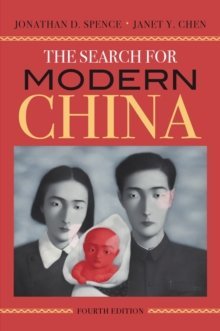 The Search for Modern China originated in a legendary course at Yale taught by the late Jonathan Spence and has been the best-selling text for students and teachers of modern Chinese history ever since. Janet Chen (Princeton University), a leading scholar and expert in social and cultural history, updates The Search for Modern China for a new generation. Incorporating insights from recent scholarship throughout, she has also streamlined the text to make it more student-friendly while maintaining the spellbinding narrative. ISBN 9781324070023


